 Myrtle Beach Mobile Home Leveling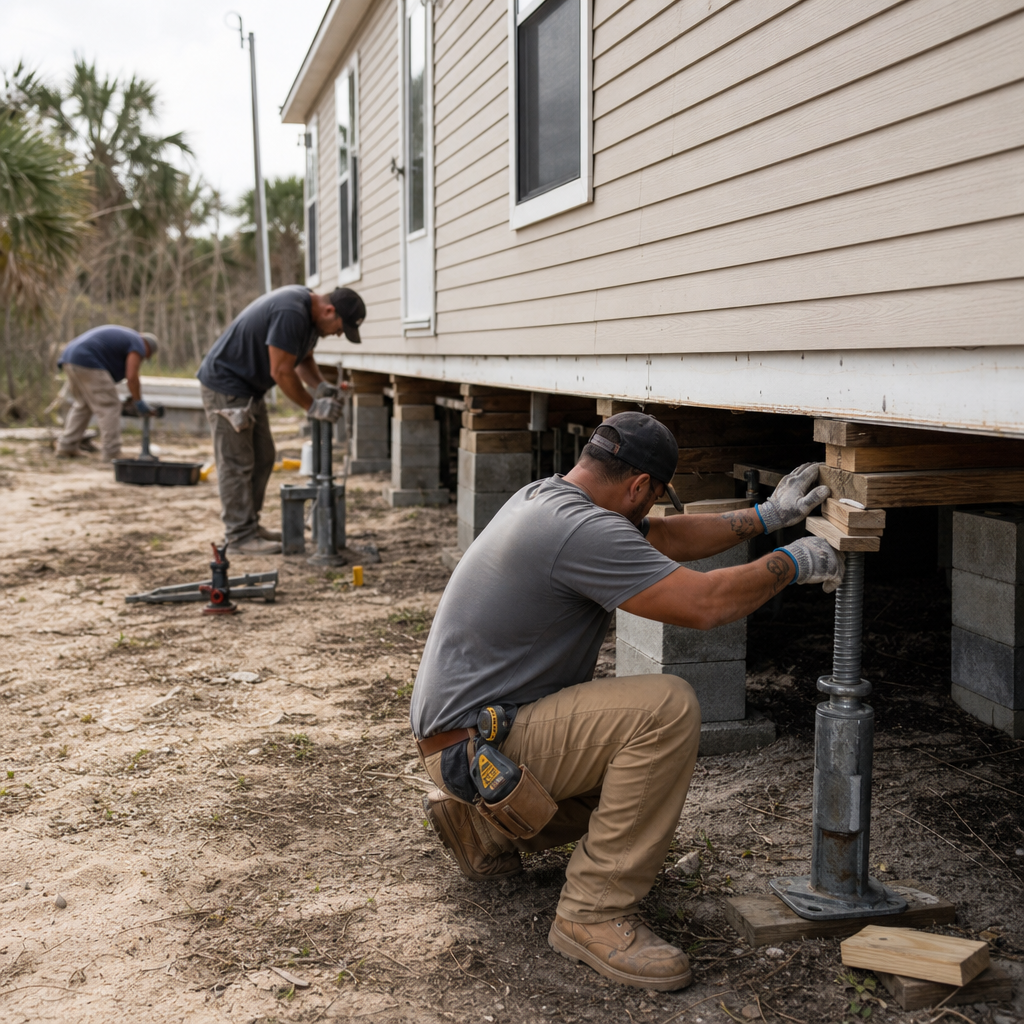
Myrtle Beach Mobile Home Leveling brings settled mobile and manufactured homes back to level across Myrtle Beach and the Grand Strand. The crew maps every pier with a water level, lifts the frame with hydraulic jacks on solid cribbing, and rebuilds the low piers with fresh shims until the whole chassis sits flat again. A singlewide relevel runs $450–$800, a doublewide $750–$1,400, and the level check that tells you exactly what you need is free.
Horry County has one of the largest manufactured-home inventories in South Carolina: dozens of parks and thousands of owned-land homes strung along US-501 toward Conway, SC-707 through Socastee, Highway 544, Highway 90, and the communities behind Surfside Beach and Garden City. Almost all of it sits on sandy coastal-plain soil with a high water table. That combination is exactly why homes here go out of level: sand compacts and washes under concentrated pier loads, and every soaking summer (never mind a storm like Florence, which dropped 23 inches of rain on the county in 2018) speeds it up. Releveling here isn’t a rare event. It’s routine maintenance, and it’s all we do.
The signs your home has settled
You rarely notice settling by looking at the home. You notice it living in it:
- Doors stick, drag, or won’t latch: the frame has racked out of square, so door openings aren’t rectangles anymore.
- Windows bind in their tracks or crack at the corners.
- Floors slope or bounce. Set a marble down; if it rolls, you’re not imagining it.
- Cracks open at wall and ceiling joints, especially over doorways.
- A doublewide’s marriage line gaps: the seam down the center opens at the ceiling or floor because the two halves are no longer sitting at the same height.
- Skirting buckles or pulls away as the home drops toward it.
Any of these is worth a free level check. Settling is progressive, a pier that’s an inch low this year is two inches low after next summer’s rain, and by then it’s crushing caps and tearing the vapor barrier. Catching it early usually means a straightforward relevel instead of a pier-rebuild job, and the difference on the invoice is measured in hundreds of dollars.
How a real relevel works
There’s no mystery to it, but there is a right way, and knowing the difference is how you avoid the guy with one jack and a bubble level.
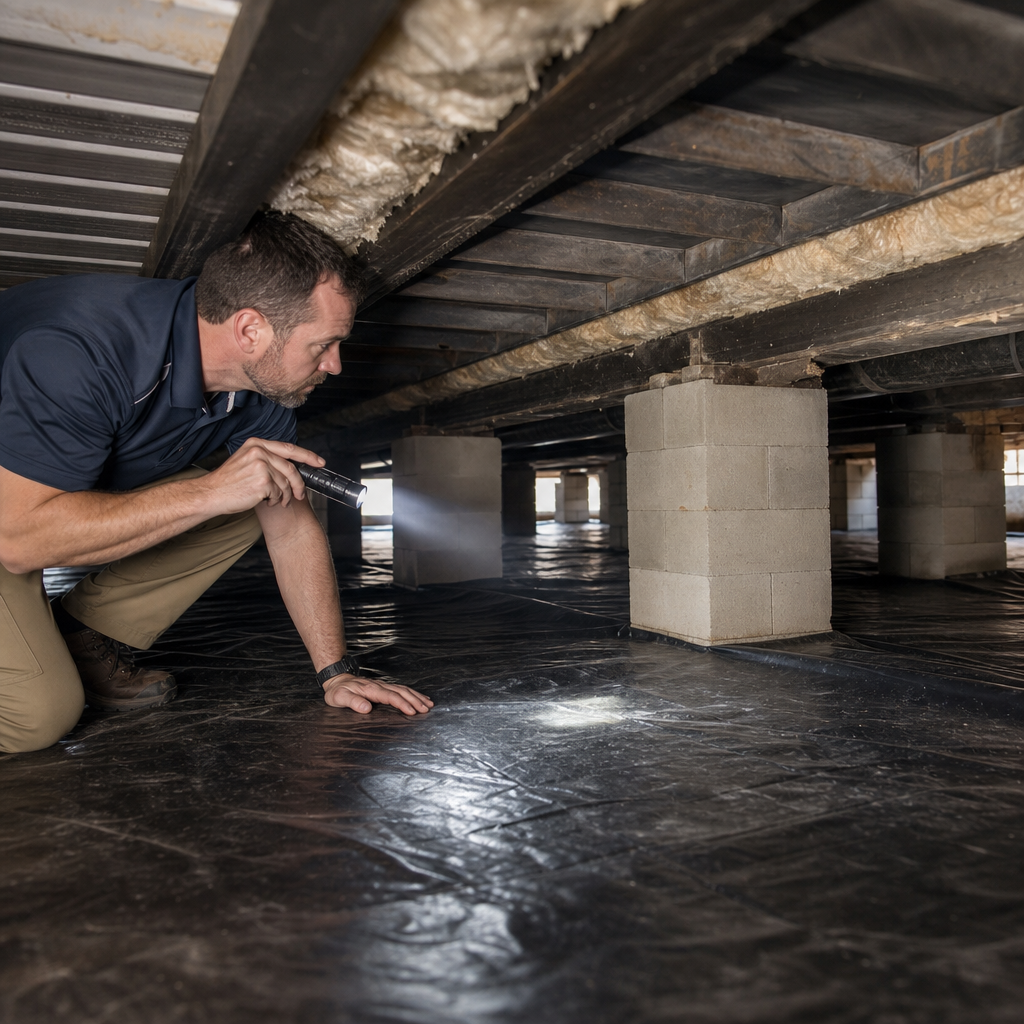
- Inspect and map. We pull skirting access panels, crawl the full length of the home, and shoot every pier with a water level off a datum pier, the most stable one. Each I-beam gets a reading, so we know exactly which piers dropped and by how much. While we’re under there, we check pads, caps, and shims for crush and rot, look at the vapor barrier, and inspect every anchor strap.
- Set the lift. Twenty-ton hydraulic bottle jacks on solid wood cribbing, placed at the frame near each low pier. The load never rides on a jack alone, cribbing carries it. We lift in small increments, working along the frame, because cranking one point far out of plane is what cracks drywall and pops trim.
- Rebuild the low piers. Re-stack or replace concrete blocks, swap out crushed or rotted caps and pads, and drive hardwood shims tight between the pier cap and the I-beam. HUD installation standards limit how tall a shim stack can be, a pier that needs a tall stack gets rebuilt, not shimmed. That’s a pier and pad repair, and we quote it per pier before touching it.
- Verify. We re-shoot the entire frame with the water level and confirm every pier carries load. A pier you can rattle by hand is carrying nothing. On doublewides, we confirm the marriage line has closed back up.
- Re-secure. Anchor straps get re-tensioned to spec, a settled home always leaves them slack, the skirting goes back on, and you get a straight rundown of anything else found under there, with prices, and zero pressure.
What we do
- Mobile home leveling: the core service. Water-level survey, hydraulic lift, new shims, whole-frame verification. Most homes done in a day.
- Pier & pad repair: reset, reshim, or fully rebuild settled block piers and footing pads. $75–$150 per pier to reset, $150–$400 to rebuild.
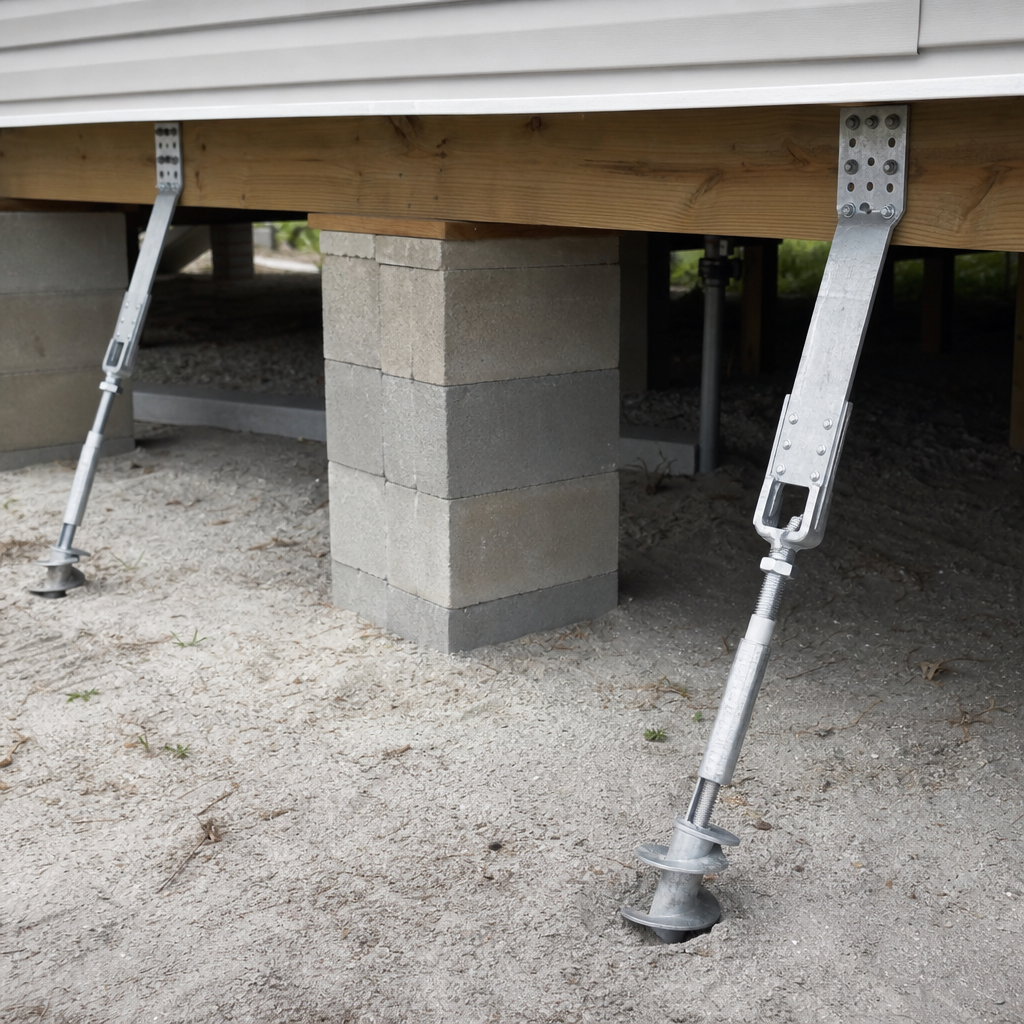
- Tie-downs & anchors: install, replace, and re-tension ground anchors and straps. All of Horry County is HUD Wind Zone II; homes and their anchoring need to handle 100-mph winds, and a lot of older setups don’t.
- Vapor barrier replacement: repair or replace the underbelly sheet that keeps ground moisture out of your floors and insulation. On our water table, a torn belly rots subfloors fast.
- Belly wrap & insulation repair, re-wrap a torn bottom board, replace fallen or soaked insulation, and reseal the ductwork sweating inside the belly. Patch $300–$800, full re-wrap $1,200–$4,500.
- Under-home moisture & drainage, stop water getting under the home in the first place: ground vapor barrier, regrading, washout repair. Wet ground is what shortens your leveling cycle.
- Skirting repair: fix or replace panels, vents, and access doors, including the storm-damage calls every summer.
- Pre-sale leveling inspection: a level, support, and tie-down check with a written report, for park requirements, lenders, and buyers. $150–$350, credited toward any work found.
- Roof-over & roof coating: roof-over systems and elastomeric or silicone coatings for tired mobile home roofs, before a leak becomes a floor problem. Coatings $1,000–$5,000, roof-overs $4,000–$12,000.
Straight pricing, published
Most outfits around here make you chase a quote. We publish our ranges:
| Service | Typical range |
|---|---|
| Relevel, singlewide | $450–$800 |
| Relevel, doublewide | $750–$1,400 |
| Pier reset/reshim | $75–$150 per pier |
| Pier rebuild | $150–$400 per pier |
| Tie-downs & anchors | $600–$3,500 |
| Belly wrap / vapor barrier | $300–$800 patch / $1,200–$4,500 full |
| Ground vapor barrier | $400–$1,200 |
| Grading & drainage | $300–$1,500 |
| Skirting | $200–$800 repair / $900–$2,500 full |
| Pre-sale inspection | $150–$350 |
| Roof coating / roof-over | $1,000–$5,000 coating / $4,000–$12,000 roof-over |
Every job starts with a free level check and a firm written number. As structural repairs go, releveling is the affordable one: a few hundred dollars on the normal cycle, versus the pier rebuilds, rotted subfloors, and racked doorframes that pile up when settling runs unchecked for years. The full breakdown, what moves the price up or down, what’s included, is on the pricing page.
Work it out before you call anyone
Three free tools, no email and no signup, and the answers appear on the page:
- Leveling cost calculator, six questions, and you get the same range we would quote over the phone, built from the table above.
- Settling self-check, twelve signs, scored. It will tell you your home is fine if your home is fine.
- Tie-down planner, how many frame ties and anchors a home your size should have under HUD Wind Zone II, which covers every acre of Horry County.
If you are buying, selling, or moving a home rather than fixing one, start with the Horry County permit checklist and how to verify an installer’s South Carolina licence.
Why the Grand Strand is hard on mobile homes
The soil. The coastal plain under Horry County is sand over a high water table, cut through with swamps and bays. Sand drains fast on top and stays saturated underneath, and under a concentrated pier load it compacts and migrates. Homes on this ground need releveling every 3–5 years. That’s not a sales line, it’s the honest maintenance cycle, and anyone who tells you a relevel is permanent on this soil is selling you something.
The rain and the storms. Summer thunderstorms saturate the ground every year, and tropical systems do worse. Florence in 2018 put the Waccamaw River at a record 21.16 feet in Conway and flooded around 2,000 homes countywide; low-lying Socastee neighborhoods along the Intracoastal have flooded repeatedly since. Saturated soil is when piers move. The fall after a wet summer is when piers show it, and homes in Conway and Socastee feel it first.
The wind history. Hugo in 1989 put a 13-foot surge through Garden City and Surfside Beach; Ian came ashore just down the coast near Georgetown in 2022 and stripped the dunes off Garden City again. Every manufactured home in Horry County sits in HUD Wind Zone II, and its anchoring system, not the home itself, is what keeps it planted in a named storm. Anchors loosen as homes settle, which is why leveling and tie-down work go together here.
The people. Myrtle Beach is the fastest-growing metro in the country for residents 65 and up, the 65+ population grew over 22% this decade and now makes up more than a quarter of the area. A lot of those retirees are buying into manufactured-home and 55+ land-lease communities from Conway to Murrells Inlet, and parks, lenders, and insurers routinely require a level-and-tie-down check when a home changes hands. If you’re buying or selling, start with the pre-sale inspection.
Licensed work, and why that matters in South Carolina
South Carolina licenses and bonds manufactured home installers through the state Manufactured Housing Board under LLR, and installation work (which includes leveling, blocking, and tie-downs on a sited home) is supposed to follow HUD’s installation standards. In unincorporated Horry County, setup and moving work also runs through County Code Enforcement permits and inspections. We say this plainly because it protects you: a home is 15,000-plus pounds of steel and lumber sitting on jacks during a lift, and an unlicensed handyman with a bottle jack from the toolbox is how homes get damaged and people get hurt. Ask any installer for a licence number and proof of insurance before the jacks come out. We will never quote you a corner-cut.
Get a free level check
Tell us the symptoms, sticking doors, a sloping hallway, a gapping marriage line, plus the home’s size and where it sits, and we’ll schedule a free level check. A park off 501, 544, 707, or Highway 90 sits in the middle of our coverage, not the edge of it. The check is quick and the quote is same-day, written out at the home while the pier readings are fresh. You get a pier-by-pier reading, a firm price, and an honest answer about what needs doing now versus what can wait. We work across Myrtle Beach, Conway, Little River, North Myrtle Beach, Socastee, Surfside Beach, Murrells Inlet, Garden City, Loris, Longs, Carolina Forest, and Aynor. Questions first? The FAQ covers most of them, or read about how we work.