 Myrtle Beach Mobile Home Leveling
 Pier & Pad Repair for Mobile Homes in Myrtle Beach
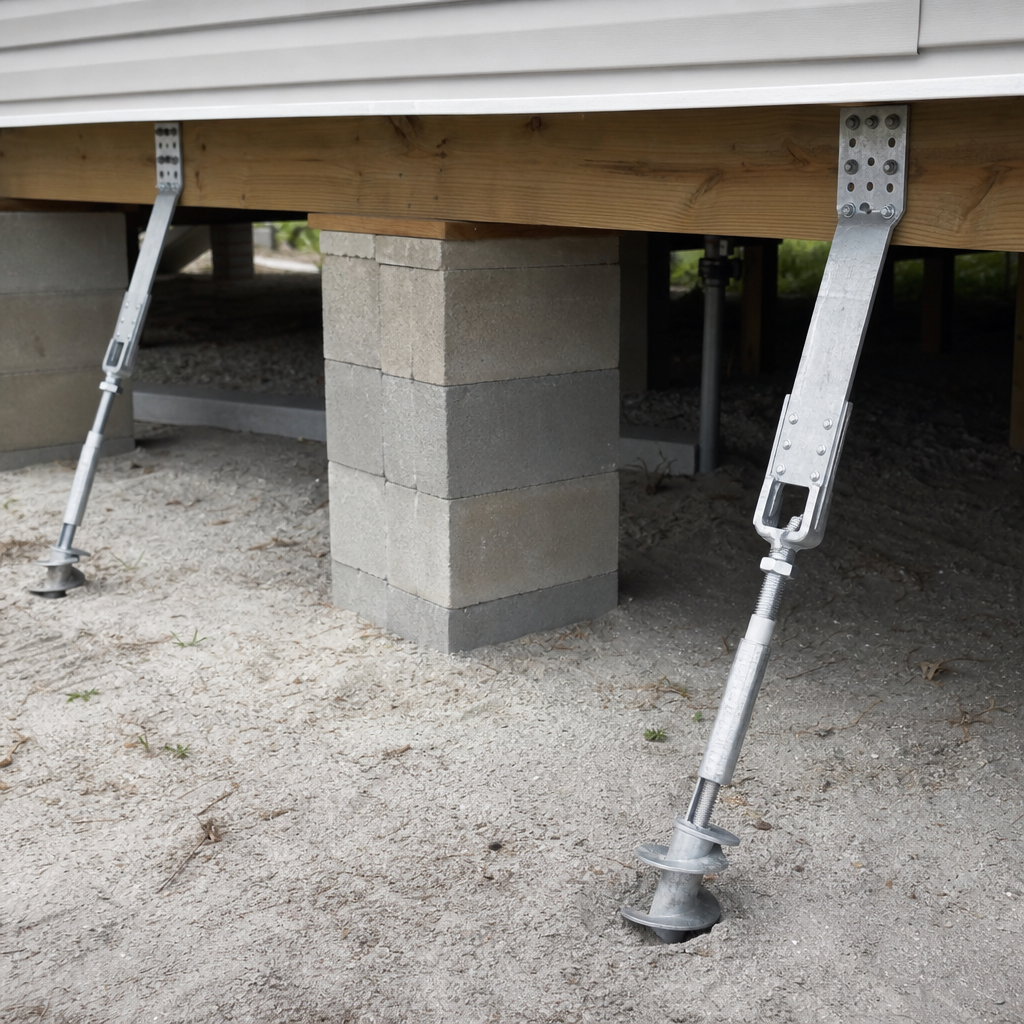
Pier and pad repair fixes the actual support structure under your mobile home: the concrete block stacks, the caps and shims on top of them, and the footing pads beneath them. On the Grand Strand this is where settling really lives: the sandy, wet soil under Horry County lets pads tilt and sink, block stacks lean, and caps crush. Resets run $75–$150 per pier, full rebuilds $150–$400 per pier, and most jobs land between $500 and $2,500 all-in, quoted pier by pier after a free survey.
A relevel puts the frame back on the level line. Pier and pad repair makes sure the things holding it there are actually sound. They usually happen on the same visit.
Anatomy of a pier, and where each part fails
From the ground up, a typical pier under a Grand Strand home:
- The pad: a concrete or ABS footing that spreads the pier’s load into the soil. Failure mode here: wet sand compacts and migrates under the pad’s edges, so it tilts and sinks. This is the number-one failure on our soil, and no amount of shimming above it fixes a footing that’s going down.
- The block stack: concrete masonry blocks, stacked open cells vertical, single- or double-stacked depending on height and load. Failure mode: a tilting pad leans the whole stack; badly stacked or overloaded blocks crack.
- The cap: solid concrete or hardwood that spans the top of the blocks and spreads the beam load. Failure mode: wood caps rot and crush in our humidity; undersized caps crack.
- The shims: hardwood wedges driven opposing between cap and I-beam to make the final tight, level contact. Failure mode: shims crush, loosen through wet-dry cycles, or were stacked too tall in the first place.
When we survey a home, every one of these gets checked at every pier, not just the elevation reading, but what the pier is made of and what condition it’s in. Homes that have been “releveled” cheaply over the years are archaeology: scrap-lumber shims, cracked caps, pads long buried below grade. Some piers end up doing nothing at all. You could rattle them by hand.
Reset vs. rebuild: the honest line
Reset/reshim ($75–$150 per pier). The pad and blocks are sound; the pier just needs to be brought back to tight, level contact. We lift the beam at that station, replace crushed shims and any failing cap, and drive new hardwood shims tight. Most piers on most jobs need only this, and it’s included in the flow of a standard relevel. Catching a pier at the reset stage is the affordable outcome. The rebuild price is what waiting buys.
Rebuild ($150–$400 per pier). The pad has tilted or sunk, blocks are cracked or leaning, or the pier would need a shim stack over the HUD allowance to reach the beam. We lift and crib the frame at that station, pull the pier out entirely, re-establish a firm, compacted footing, larger pad where soil conditions call for it, and restack plumb at the correct height with a proper cap and fresh shims.
The line between the two isn’t judgment-call fuzzy; it’s mostly the HUD installation-standard limit on how much shim and lumber can sit on top of a pier. If a pier needs more than the allowance to reach the beam, stacking taller is against the standard and unstable in practice. It gets rebuilt. Crews that skip this rule leave behind wobbling Jenga stacks that turn up years later.
Why Grand Strand soil eats pads
Peninsular Horry County is coastal-plain sand over a high water table, threaded with swamps and drainage bays. Sand carries load fine when it’s confined and dry; under a small concentrated footing in ground that saturates every summer, it compacts and squeezes sideways. Add our rain events, Florence put 23 inches on the county in 2018 and left ground saturated for weeks, and pads move. Homes in low-lying spots near the Intracoastal in Socastee and the river country around Conway see it worst; even the higher sandy ridges inland of Surfside Beach aren’t immune, just slower.
This is also why we’re straight with owners: pier repair on this soil is durable, not eternal. A properly rebuilt pier on a well-set pad lasts years longer than what it replaced, but if water keeps ponding along a pier line, the soil keeps moving. When drainage is the root cause, we say so, because fixing a downspout is cheaper than rebuilding the same pier twice.
What a pier job includes
- Water-level survey of every pier, elevation plus physical condition, before any quote
- Frame lifted on 20-ton jacks over solid cribbing at each work station, the load never rides on a jack alone
- New materials: blocks, solid caps, pads sized to the load, kiln-dried hardwood shims
- Re-verification of the full frame after the work, every pier carrying load, marriage line matched on doublewides
- Anchor straps re-tensioned, since pier work changes the frame height they were tensioned to. See tie-downs & anchors
- A written pier-by-pier breakdown: what was done, what was left alone and why
Anything else found under there, a torn vapor barrier, skirting damage, plumbing drips, gets reported, not silently billed.
Who does the work
South Carolina licenses and bonds manufactured home installers through the state Manufactured Housing Board (LLR), and support work under a sited home is installer work under HUD standards. Whoever rebuilds the piers, check their state licence first. This trade has a long tail of unlicensed operators around here, the tall shim stacks are their signature, and the few hundred dollars they save you up front becomes a rebuild bill later.
Get the survey first
Whether you need two piers reset or a dozen rebuilt, the free level check settles it with numbers instead of guesses: every pier shot, every condition noted, every price itemized in writing. See the full cost tables on the pricing page, then request the survey. We work across Myrtle Beach, Conway, Socastee, Surfside Beach, and Murrells Inlet, most of the Grand Strand is within a half-hour of the crew.
Frequently Asked Questions
What does pier repair cost in the Myrtle Beach area?
Resetting and reshimming a pier during a relevel runs $75–$150 per pier. A full rebuild (new blocks, cap, and pad) runs $150–$400 per pier. Typical pier-and-pad jobs land between $500 and $2,500 all-in, and every pier is quoted individually after the free survey.
How do piers fail on sandy soil?
Usually from the bottom up: the pad, the footing under the block stack, tilts or sinks as saturated sand compacts and migrates beneath it, and the pier leans or drops with it. Caps and shims also crush over time as they carry load through wet-dry cycles. A leaning pier is a pad problem wearing a block costume.
Can you just add more shims to a low pier?
Up to a point, HUD installation standards limit how tall the shim and lumber stack on top of a pier can be. A pier that needs more than the allowance gets rebuilt at the right height instead. Tall shim stacks are exactly what you find under homes that had cheap 'relevels,' and they're unstable by design.
How many piers does a mobile home have?
Most singlewides carry 12–20 piers under two I-beam rails; doublewides add a marriage-line row down the center and commonly run 20–30+. On a typical Grand Strand repair job, only a handful need real work. The survey tells us exactly which ones, so you never pay for rebuilding piers that are sound.
Do rebuilt piers need a permit in Horry County?
Routine like-for-like pier repair under an existing home generally doesn't, but larger scopes (setup work, relocations, structural changes) run through Horry County Code Enforcement permits and inspections. When the scope requires it, the licensed installer pulls the permit and the fee passes through at cost.
More mobilehome services
- Mobile Home Leveling & Releveling in Myrtle Beach
- Tie-Downs & Ground Anchors for Myrtle Beach Mobile Homes
- Underbelly & Vapor Barrier Replacement in Myrtle Beach
- Belly Wrap & Underbelly Insulation Repair in Myrtle Beach
- Mobile Home Skirting Repair & Replacement in Myrtle Beach
- Pre-Sale Leveling Inspection for Mobile Homes in Myrtle Beach
- Under-Home Moisture & Drainage in Myrtle Beach
- Mobile Home Transport & Setup in Myrtle Beach and Horry County
- Utility Hookups for Newly Set Mobile Homes in Myrtle Beach
- Mobile Home Roof-Over and Roof Coating in Myrtle Beach