 Myrtle Beach Mobile Home Leveling
 Mobile Home Leveling & Releveling in Myrtle Beach
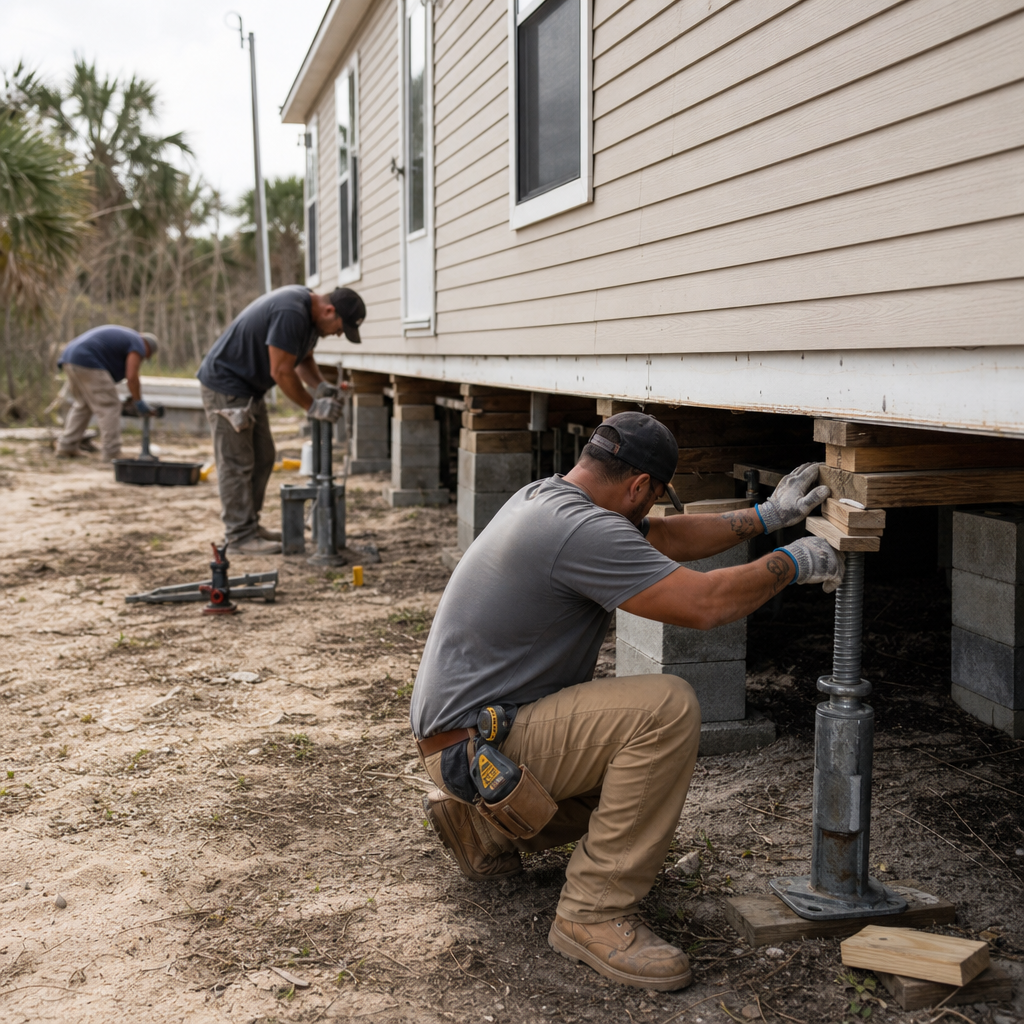
Releveling re-establishes a flat, evenly supported steel chassis under your mobile home after the support piers settle, and on the sandy soil under Myrtle Beach and the Grand Strand, piers settle on a schedule. The crew maps every pier with a water level, lifts the I-beams with 20-ton hydraulic jacks on solid cribbing, and rebuilds each low pier with fresh hardwood shims until the whole frame sits back on the level line. Singlewides run $450–$800, doublewides $750–$1,400, and nearly every home is done in a single day.
If your doors have started sticking, your floors have developed a lean, or the ceiling seam of your doublewide is opening up, this is the service that fixes it.
Why homes settle here
A manufactured home concentrates its entire weight onto a few dozen pier footprints, each maybe two square feet. Under Horry County, those footprints press into coastal-plain sand sitting over a high water table. Sand under concentrated load compacts, and when it’s saturated it migrates, every soaking summer thunderstorm season works the pads a little deeper and a little more unevenly. A year like 2018, when Florence dropped 23 inches of rain on the county and put the Waccamaw at record flood through Conway, moves piers measurably.
The result: on this ground, a relevel every 3–5 years is normal. Homes on high, well-drained pads stretch that; homes in low spots near the Intracoastal in Socastee or the river lowlands around Conway shorten it. Anyone who tells you a relevel on Grand Strand sand is permanent hasn’t spent time under homes here, or is hoping you haven’t.
The symptoms, from mild to urgent
- Early: a door that rubs seasonally, a hairline crack over a doorway, a slight bounce in one room’s floor.
- Established: doors that won’t latch, windows binding in tracks, a visible slope you can feel walking the hallway, skirting starting to buckle.
- Urgent: a marriage-line gap you can see daylight or feel airflow through, floors soft or clearly tilted, piers visibly leaning or shimmed with scrap, straps hanging slack.
Early-stage settling is the cheap fix, often reshimming a handful of piers inside the base relevel price. Established settling still relevels cleanly. Urgent-stage homes usually need pier rebuilds alongside the relevel, and every season of waiting adds piers to that list.
How the relevel actually works
1. Survey. We pull skirting access panels and crawl the home end to end. Every pier gets shot with a water level off a datum pier, the most stable one, so we have a number for each I-beam point: this pier is down 3/4”, this one 1-5/8”, these six are true. While we’re under there we check every pad, cap, and shim for crush and rot, inspect the vapor barrier, and eyeball every anchor strap. You get the map and a firm price before anything else happens.
2. Lift. Twenty-ton hydraulic bottle jacks go on solid wood cribbing at the frame near each low pier. The rule that separates pros from pretenders: the load never rides on a jack alone, cribbing carries it, always. We lift in small increments, moving station to station along the frame, so the chassis returns to plane as a unit. Cranking one point three inches in one go is how drywall cracks and doorframes rack, so we don’t.
3. Rebuild the piers. At each corrected pier: re-stack or replace concrete blocks as needed, replace crushed or rotted caps and pads, and drive hardwood shims tight between the cap and the I-beam. HUD installation standards cap how tall a shim-and-lumber stack may be, a pier that needs more than the allowance gets rebuilt properly, not stacked taller. That’s the honest line between a relevel and a repair, and we price it per pier, in the open.
4. Verify. The entire frame gets re-shot with the water level. Every pier must carry load. A pier you can rattle by hand is decorative, not structural. On doublewides we confirm the marriage line has closed and both halves read matched.
5. Re-secure. Anchor straps get re-tensioned to spec, because a settled home always leaves them slack, and slack straps are worthless in the storms this coast actually gets. If the anchor system itself is short, rusted, or pre-dates modern wind standards, we tell you and quote tie-down work separately. Skirting goes back on, and you get the full under-home report either way.
Singlewides vs. doublewides
A singlewide has two I-beam rails and typically 12–20 piers; the survey and lift are straightforward, which is why most run $450–$800 and take 3–5 hours.
A doublewide adds a third structural problem: the marriage line, the pier row carrying the joined edges of both halves down the center of the home. Those piers have to come back up matched to both sections simultaneously, or the seam stays stressed at the ceiling, floor, and roof connection. It’s slower, more careful work: $750–$1,400 and 6–8 hours. A gapping marriage line is also the symptom owners most often ignore, because it’s overhead instead of underfoot. Don’t. It’s the home telling you the center row is sinking.
Releveling a home with brick underpinning
Some homes around Horry County are closed in with brick instead of vinyl skirting, often on owned land where the home is meant to stay. A relevel on one of these is normally done from inside the crawlspace. On most installations the brick is a curtain wall: it encloses the space under the home and the frame rests on the piers inside it. The jacks go in through the access opening, the piers are reset, and the brick stays where it is. HUD’s installation standards require that opening to be at least 18 inches wide, 24 inches high and 3 square feet, placed so the utility connections under the home can be reached, which is also roughly the space a person needs to get a jack and blocks through. A brick wall with a smaller opening, or one blocked by a step or an AC pad, has to be dealt with before anyone can work underneath.
Where the brick meets the siding is the part to look at. The same standards say skirting must not trap water against the siding or be attached in a way that stops the home’s exterior covering from expanding and contracting. When brick was laid tight up under the siding, or the home has settled down onto the top course, the brick ends up carrying weight it was never meant to carry and the siding above it stays damp. Raising the frame back to level then opens a gap along that joint, which needs flashing or trim closed over it afterward. If the floor framing sits directly on the brick all the way round, the wall is acting as a perimeter foundation rather than skirting, and the relevel has to be planned around it.
Check the vents while you are at it. A skirted crawlspace needs at least 1 square foot of net vent area for every 150 square feet of floor, on at least two opposite sides, set as high as practical with rodent-proof screens. A 28x60 doublewide is 1,680 square feet, so about 11 square feet of vent. Brick walls are often built with too few vents, and a damp crawlspace is one of the reasons piers settle on this coastal ground in the first place.
For a quote, useful photos are the access opening, a corner of the brick where it meets the siding, and one of the vents.
What it costs, and what moves the number
| Situation | Expect |
|---|---|
| Routine relevel, most piers reshimmed | $450–$800 single / $750–$1,400 double |
| + piers needing reset | +$75–$150 per pier |
| + piers needing full rebuild | +$150–$400 per pier |
| Severely settled, poor access, wet ground | quoted after survey |
The pricing page has the complete tables, including tie-downs, vapor barrier, and skirting. Every number is confirmed in writing after the free survey: we quote from pier readings, not from a phone guess. Two things worth knowing about that quote: it lands the same day as the survey, and it stays on the affordable end of structural work as long as the home is releveled on its normal cycle, deferred settling is what converts shim money into pier-rebuild money.
After the relevel: making it last
The relevel fixes the elevation; it doesn’t change the soil. Three things stretch the cycle on Grand Strand ground: keep gutter and yard drainage moving water away from the pier lines, keep the skirting ventilated so the crawl space isn’t a swamp, and fix pad problems when we flag them instead of re-shimming over them. Owners who do those three routinely get the long end of the 3–5 years. Either way, a periodic check, free, beats waiting for the doors to stick again.
Ready to know where your home stands? Request a free level check. We serve Myrtle Beach, Conway, Surfside Beach, Murrells Inlet, and Socastee, and the answer, pier by pier, in writing, costs nothing. And if “mobile home releveling near me” is what got you here, from a park lot on the corridors or a family place on private land, the free check is the same next step either way.
Frequently Asked Questions
What does releveling a mobile home in Myrtle Beach cost?
Singlewides run $450–$800 and doublewides $750–$1,400, including the pier survey, lift, new shims, and strap re-tension. Severely settled homes needing pier rebuilds run higher, quoted per pier before work starts. The level check itself is free.
How long will my home be up on jacks?
It isn't, in the way people picture. The frame is lifted in small increments, fractions of an inch at a time, at multiple stations, with the load carried on solid cribbing, never a jack alone. A singlewide is done in 3–5 hours, a doublewide in 6–8, and you can be home the whole time.
Will releveling crack my walls?
A careful relevel is what prevents cracking. Damage happens when someone cranks one point far out of plane with a single jack. We lift small amounts across the frame in sequence, so the home moves back to level as a unit. Homes that sat badly settled for years may show some existing cracks close up, and occasionally reveal ones the settling caused.
How out of level is too out of level?
There's no magic number, but as a rule: under half an inch across the frame is watch-and-wait; an inch or more, or any symptom you can feel (sticking doors, sloping floors, a gapping marriage line) means schedule it. Settling compounds, and a pier that's low keeps crushing its caps and shims until it's rebuilt.
Can a doublewide with brick underpinning be releveled?
Usually, yes, without taking the brick down. On most homes the brick is a curtain wall around the crawlspace and the house sits on piers inside it, so the jacks go in through the access opening and the brick never moves. Two things change the job: an access opening too small or blocked to work through, and brick laid tight against the siding, where raising the home opens a gap or the settled home is resting its weight on the brick. Photos of the access door and of the joint where the brick meets the siding answer both.
Do you level homes in parks and on private land both?
Yes. Park homes along the 501, 707, 544, and 90 corridors and owned-land homes out toward Conway and Bucksport get the same process. In parks we coordinate with management where required; on private land in unincorporated Horry County, any permit-triggering scope runs through County Code Enforcement.
More mobilehome services
- Pier & Pad Repair for Mobile Homes in Myrtle Beach
- Tie-Downs & Ground Anchors for Myrtle Beach Mobile Homes
- Underbelly & Vapor Barrier Replacement in Myrtle Beach
- Belly Wrap & Underbelly Insulation Repair in Myrtle Beach
- Mobile Home Skirting Repair & Replacement in Myrtle Beach
- Pre-Sale Leveling Inspection for Mobile Homes in Myrtle Beach
- Under-Home Moisture & Drainage in Myrtle Beach
- Mobile Home Transport & Setup in Myrtle Beach and Horry County
- Utility Hookups for Newly Set Mobile Homes in Myrtle Beach
- Mobile Home Roof-Over and Roof Coating in Myrtle Beach